Team Wear has moved beyond matching shirts and printed numbers. Clubs now expect durable fabrics, accurate sizing, reliable delivery, and responsible production. Grand View Research valued the global sports apparel market at approximately USD 248.6 billion in 2023. It projects a 6.8% compound annual growth rate from 2024 to 2030. This broader figure includes Team Wear, training apparel, and fan merchandise. It is useful, but not perfectly specific.
McKinsey & Company and the World Federation of the Sporting Goods Industry reported continued sports industry growth after 2019. Their analysis also highlights stronger demand for performance, personalization, and direct-to-consumer services. These shifts affect every purchasing decision. A buyer may compare sublimation clarity, fabric recovery, stitching around the shoulder, minimum order quantities, and customs-ready documentation. Small details become expensive when 2,000 jerseys arrive with inconsistent sleeve lengths. No ranking is flawless. Price alone can mislead.
As sports-industry analyst Matt Powell has often emphasized, “The consumer is the boss.” That idea applies to clubs, schools, and athletes choosing Team Wear suppliers. The following selection examines ten manufacturers for global buyers, including Joma Sport, Kappa, Macron, Erreà, O’Neills Sportswear, and selected specialists serving China OEM Seamless Yoga Wear Factories. Evaluation focuses on manufacturing experience, customization depth, quality control, order flexibility, delivery transparency, and evidence of international service. Buyers should still verify certifications, sample quality, factory ownership, and current lead times before signing an agreement. A polished catalogue proves little. Consistent production does.
Global teamwear buying is no longer judged by design alone. Textile Exchange reported global fiber production at about 124 million tonnes in 2023, with continued growth expected by 2030. This scale increases pressure on manufacturers to document fiber origin, recycled content, and processing stages. ITMF’s 2024 industry updates also showed uneven demand, cautious ordering, and persistent inventory concerns across textile markets. Buyers should request current production records, not attractive claims.
A reliable teamwear manufacturer should explain fabric weight, colorfastness, shrinkage, and testing methods clearly. Ask for a sample washed several times. Check whether the crest remains sharp and whether seams twist after drying. Small details reveal factory discipline. Production capacity matters, but consistency matters more. Some suppliers quote impressive volumes without showing seasonal staffing plans or quality-control checkpoints. That deserves reflection.
Searches for China OEM Seamless Yoga Wear Suppliers may also lead buyers toward factories producing stretch team garments. Their expertise can support compression panels, seamless zones, and flexible movement. However, teamwear requires more than soft fabric. It needs durable stitching, accurate sizing, dependable replenishment, and transparent documentation. A practical shortlist should compare sample results, audit evidence, lead times, and communication quality. The cheapest offer can become expensive after one poor tournament shipment.
A serious Top 10 ranking for global buyers should measure capacity, MOQ, lead time, defect rate, and AQL together. Capacity means more than monthly output. It includes fabric availability, cutting lines, sewing teams, and backup production. The ITMF Global Textile Industry Survey 2024 reported continued demand uncertainty, making flexible capacity more valuable than impressive factory size. A supplier with 100,000 pieces of capacity may still struggle with a 2,000-piece order.
MOQ affects cash flow and design testing. Lead time should include fabric booking, sampling, production, inspection, and shipping. The World Bank’s Logistics Performance Index 2023 highlights major differences in international logistics reliability. A quoted 30-day lead time may become 45 days during peak sports seasons. Get the calendar in writing.
Defect rate needs measured evidence, not a confident promise. ISO 2859-1 uses sampling plans for acceptance inspections, while AQL is a sampling limit, not a guaranteed defect percentage. AQL 2.5 does not mean every shipment contains exactly 2.5% defects.
For Global Custom Tennis Wear Manufacturers, buyers should request recent inspection records, size measurements, color approvals, and photos of packed cartons. Check collar stretch and logo placement. Small details matter. A neat spreadsheet can still mislead. I would also compare two production runs, because one successful sample may hide inconsistent sewing quality.
For global buyers, factory capability starts with evidence, not attractive sample photos. The ISO Survey 2022 recorded 1,265,216 ISO 9001 certificates worldwide. Yet certification alone does not guarantee consistent teamwear. Buyers should verify the certificate scope, audit date, corrective-action records, and production-site address. A factory claiming ISO 9001 should show controlled measurements for fabric weight, color tolerance, seam strength, and shipment inspection.
Sublimation requires more than a large printer. It needs stable polyester fabric, calibrated temperature, controlled pressure, and accurate color profiles. Textile Exchange’s 2024 Materials Market Report reported that polyester represented about 59% of global fiber production in 2023. This supports sublimation’s wide material base, but not every polyester fabric prints equally well. Ask for wash-test results, colorfastness data, and a printed panel before bulk approval. Small shade differences can become obvious across a full team order.
Embroidery and screen or digital printing need separate checks. Buyers should inspect stitch density, backing material, needle marks, print adhesion, and artwork registration. The Global Organic Textile Standard requires defined processing controls, but a factory’s general claim is not enough; certification scope must match the supplied product. Request an independent pre-shipment inspection. It may reveal loose threads or uneven logos. That is inconvenient, but useful. A factory can pass one sample review and still struggle during peak production. This risk deserves honest discussion.
Anonymized benchmark of documented production capabilities among ten global teamwear suppliers
The chart compares the share of reviewed suppliers offering key factory capabilities. ISO 9001 refers to a certified quality-management system, while sublimation, embroidery, screen printing, and heat-transfer printing represent commonly used teamwear decoration processes. Values are shown as percentages of the anonymized ten-supplier benchmark.
For buyers comparing the Top 10 Team Wear Manufacturers for Global Buyers, material evidence matters more than polished samples. A supplier should state polyester fiber type, recycled content, yarn construction, and test method. In team uniforms, 150–180 GSM often balances airflow and durability. Heavier 200–240 GSM fabric feels stronger, but may retain more heat during intense play. These figures need fabric swatches and laboratory reports.
should provide GSM tolerance, not only a nominal number. A 180 GSM claim may vary across panels or production batches. Check colorfastness against washing, perspiration, dry rubbing, and wet rubbing. Ratings of 4 or above are generally practical targets, but performance can differ after repeated care. I have seen attractive samples fade near seams. That detail is easy to miss. OEKO-TEX® documentation should include a valid certificate number, product scope, and renewal date. A printed symbol alone proves very little.
Tips: Request three production swatches, not one. Measure GSM after conditioning the fabric. Wash each sample five times and photograph color changes under daylight. Ask whether the reported result covers trims, prints, and thread. My own mistake was trusting a laboratory sheet without checking its test date. Documents can be accurate, yet incomplete for the final garment.
For global teamwear buyers, compliance starts before fabric cutting. REACH controls chemicals in EU-bound garments, including dyes, prints, elastics, and metal trims. ECHA’s REF-11 enforcement project inspected 2,407 consumer products and found about 18% non-compliant. That result deserves attention. A jersey can look clean while its transfer print contains restricted substances.
Experienced sourcing teams should request current laboratory reports for each material batch. They should also map suppliers, production lots, and chemical declarations. China OEM Rugby Football Wear Suppliers need clear specifications for azo dyes, phthalates, lead, and nickel release. REACH Article 33 communication may apply when a Candidate List substance exceeds 0.1% in an article. Testing only the finished shirt is not always enough.
For children’s rugby kits entering the United States, CPSIA requirements become more detailed. Children’s products generally need third-party testing, a Children’s Product Certificate, tracking information, and limits for lead and phthalates. CPSC guidance also emphasizes small-parts hazards, drawstrings, and accessible trims. The statutory lead limit for accessible parts is 100 ppm, while paint and surface coatings are limited to 90 ppm. CPSC annual reporting shows continuing recalls across children’s product categories, so paperwork cannot replace physical checks. In practice, buyers should inspect neck labels, snaps, badges, and packaging. One weak trim can delay a shipment. Compliance files are often incomplete, and that is a risk worth admitting early.
| No. | Compliance Dimension | EU / EEA — REACH | United States — CPSIA / CPSC | Relevant Teamwear Risk | Documents or Controls to Request |
|---|---|---|---|---|---|
| 1 | Supplier chemical management | REACH applies to substances, mixtures and articles placed on the EU/EEA market. Manufacturers should control restricted substances under Annex XVII and monitor the Candidate List of Substances of Very High Concern. | CPSIA requirements apply primarily when the teamwear is designed or intended for children aged 12 or under. Adult-only products are generally outside the children’s-product testing and certification framework. | Uncontrolled dyes, finishes, prints, trims or packaging may create market-access and recall risks. | Chemical restricted substances list, supplier declarations, approved chemical list and change-control procedure. |
| 2 | SVHC communication | If an article contains a Candidate List SVHC above 0.1% by weight, suppliers may have information duties under REACH Article 33. Additional SCIP notification obligations can apply to relevant EU supply-chain placements. | There is no direct U.S. equivalent to the EU SVHC communication system, but product-specific federal, state and retailer chemical restrictions may still apply. | PVC badges, rubberized logos, elastics, coatings and specialty finishes can contain reportable substances. | Current REACH Candidate List screening, material composition file and SVHC declaration for each component. |
| 3 | Restricted azo colorants | REACH Annex XVII restricts certain azo colorants in textile and leather articles that may come into direct and prolonged contact with human skin or the oral cavity. | CPSIA does not create a general azo-dye limit equivalent to the EU rule; buyers may still impose retailer, state or brand chemical requirements. | Jerseys, base layers, socks and compression garments have prolonged skin contact. | Azo-dye test report from an ISO/IEC 17025 laboratory and dye-house batch traceability. |
| 4 | Phthalates in plasticized components | REACH Annex XVII restricts specified phthalates in plasticized materials, including certain articles supplied to the EU market, subject to the applicable scope and concentration limits. | For covered children’s products, CPSIA restricts specified phthalates to 0.1% or less in accessible plasticized components. | Flexible name sets, screen prints, PVC numbers, grips, synthetic leather patches and rubberized emblems. | Component-level phthalate testing, material declarations and verification that accessible components are included in the test plan. |
| 5 | Lead in coatings and accessible parts | EU requirements depend on the material and applicable REACH restrictions; suppliers should assess printed, coated, metallic and polymeric components rather than relying only on fabric testing. | For children’s products, CPSIA limits lead in paint and similar surface coatings to 90 ppm and total lead content in accessible component parts to 100 ppm, subject to statutory exclusions and applicable rules. | Metal snaps, zip pulls, coated logos, foil prints, buckles and decorative hardware may be accessible to children. | Lead test reports by component, bill of materials and accessibility assessment for children’s styles. |
| 6 | Children’s product testing and certification | REACH compliance is normally demonstrated through risk assessment, technical documentation, supplier controls and testing where appropriate; an EU-wide equivalent to the U.S. CPC is not generally required for ordinary apparel. | Manufacturers and importers of regulated children’s products must issue a Children’s Product Certificate (CPC) based on applicable testing by a CPSC-accepted third-party laboratory. | Youth team kits may be treated differently from adult uniforms because of intended age grading and marketing. | Age-grading rationale, applicable test list, laboratory accreditation details and CPC-ready product records. |
| 7 | Flammability of clothing textiles | EU buyers should assess the applicable national or product-specific fire-safety rules and intended use; REACH itself is not a general textile flammability standard. | U.S. wearing apparel is generally subject to the CPSC flammability standard in 16 CFR Part 1610. Children’s sleepwear has additional requirements under 16 CFR Parts 1615 and 1616 where applicable. | Brushed polyester, fleece, mesh, heat-transfer films and loose-fitting youth garments require careful classification. | Fabric flammability reports, product classification, garment construction details and sleepwear determination where relevant. |
| 8 | Tracking labels and traceability | EU product traceability and textile labeling obligations depend on the product and destination market; records should identify the responsible economic operator and production batch. | CPSIA Section 103 generally requires tracking labels on covered children’s products, identifying manufacturer or private-labeler, production location and date, and batch or run information where practicable. | Custom names, numbers and mixed production lots can make defect investigation difficult. | Lot-code system, production records, factory-to-order traceability and retain-sample procedure. |
| 9 | Labels and fiber composition | EU textile products generally require fiber-composition labeling under Regulation (EU) No 1007/2011, using prescribed fiber names and translated language requirements for the destination country. | U.S. textile products generally require fiber-content disclosure, country-of-origin information and responsible-company identification under FTC textile labeling rules, subject to exemptions. | Moisture-management claims, recycled content claims and fiber blends may not match the approved specification. | Approved label artwork, fiber verification, country-of-origin review and claim substantiation file. |
| 10 | Quality, recall and corrective action | EU operators should maintain technical and supply-chain records sufficient to demonstrate compliance and support corrective action or withdrawal when a product is unsafe or non-compliant. | CPSC can investigate, require reporting and pursue recalls for defective or hazardous products. A manufacturer’s compliance program should support rapid incident reporting and corrective action. | Incorrect age grading, detached trims, choking hazards, chemical nonconformity and labeling errors can affect entire team orders. | Pre-shipment inspection plan, defect limits, complaint log, recall procedure, corrective-action report and retention period for compliance records. |
Reference framework: European Chemicals Agency (ECHA) REACH guidance and Candidate List; U.S. Consumer Product Safety Commission (CPSC) guidance for CPSIA, Children’s Product Certificates, tracking labels and textile flammability; U.S. Federal Trade Commission textile labeling rules. Final obligations depend on product construction, intended age, claims, destination country and applicable exemptions.
For global buyers, team wear pricing begins with Incoterms, not the factory quote. Under Incoterms 2020, FOB places export clearance and loading duties with the seller, while the buyer controls the main freight. CIF includes cost, insurance, and freight, but risk transfers earlier, once goods are loaded. That detail can surprise new buyers. A low unit price may hide destination charges, customs fees, or storage costs.
Freight planning needs real shipment details. A carton of folded jerseys takes less space than boxed protective wear, yet dimensional weight can still increase air-freight charges. UNCTAD’s Review of Maritime Transport 2023 reports that ships carry over 80% of global merchandise trade by volume. Ocean freight usually suits larger teamwear orders, while air freight protects urgent tournament deadlines. Rates remain unstable, so buyers should request validity dates and separate origin, ocean, destination, and handling charges.
The WTO World Trade Statistical Review 2023 valued global clothing exports at about US$576 billion in 2022. That scale shows a competitive market, but not a simple one. Buyers comparing the top 10 team wear manufacturers should check production experience, test records, carton accuracy, and delivery evidence. A supplier’s “best price” is incomplete without landed cost. I have seen buyers overlook duty classification and pay more than expected. That mistake is avoidable, though not always easy to predict. A written cost sheet helps. So does questioning every assumption.
A credible Top 10 team wear manufacturer list should begin with buyer fit, not factory size. Clubs usually need flexible minimum order quantities, fast repeat production, and durable fabrics for weekly training. Schools often value simple size grading, clear safeguarding policies, and reliable delivery before term starts. Federations require stricter testing, documented labor standards, and consistent national-color matching across seasons.
Brands need a different manufacturing partner. They may request custom patterns, private labeling, fabric development, and small pilot runs before scaling. A factory that serves every buyer equally may serve none exceptionally well. That assumption is too neat. Production records, sample revisions, and factory communication often reveal more than a polished catalog.
Industry data supports a careful approach. McKinsey’s Sporting Goods 2025 report projected roughly 5% annual industry growth from 2021 to 2025, increasing pressure on capacity and lead times. Textile Exchange’s Materials Market Report 2024 found polyester represented about 59% of global fiber production in 2023. Buyers should therefore ask about recycled content, moisture management, colorfastness, and end-of-life options. Intertek and ISO testing references can strengthen verification, but paperwork is not proof of perfect execution. Request a pre-production sample, wash-test it, and compare measurements against the approved specification. Small details matter.
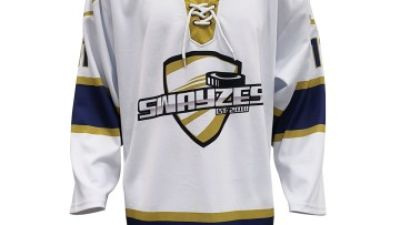
Personalized ice hockey jerseys are gaining attention as players, teams, schools, and recreational groups increasingly seek apparel that combines performance, identity, and comfort. Market insights from leading industry reports suggest that demand is being supported by the growth of organized hockey, fan participation, team customization, and online apparel purchasing. Buyers are showing greater interest in flexible designs, durable fabrics, personalized logos, and color options that reflect individual or team identity. This trend makes customized jerseys a practical choice for both competitive events and everyday training.
Made from 100% polyester, this high-quality ice hockey jersey is designed for demanding sports environments. Its breathable, quick-drying, durable, and antibacterial properties help support comfort during intense activity, while the loose fit allows unrestricted movement during skating, tackles, sprints, and shots. The pullover long-sleeve construction provides reliable coverage, and fully dye-sublimated printing helps maintain vivid designs through repeated use. Sturdy seams and advanced needle detection technology further contribute to a polished and dependable finish.
The front logo can be customized according to user preferences, enabling teams and individuals to create distinctive apparel for competitions, practice sessions, clubs, or special events. With its balance of personalization, durability, and athletic functionality, the jersey responds to the evolving expectations of the ice hockey apparel market.
Check dyes, prints, elastics, metal trims, and fabric treatments. Request current laboratory reports for every material batch. A clean-looking jersey may still contain restricted substances.
Not always. Test important components separately, including transfer prints, badges, snaps, and elastic parts. Map suppliers, production lots, and chemical declarations.
Communication may apply when a Candidate List substance exceeds 0.1% in an article. Keep clear declarations and supporting laboratory records.
Children’s products generally need third-party testing, a Children’s Product Certificate, and tracking information. Keep records linked to production lots. Missing paperwork creates avoidable delays.
Inspect neck labels, snaps, badges, drawstrings, packaging, and other accessible trims. Check for small parts and loose attachments. One weak trim matters.
Accessible parts generally require a lead limit of 100 ppm. Paint and surface coatings generally require a 90 ppm limit. Phthalate controls also apply.
Clubs may need low minimum orders, quick repeats, and durable training fabrics. Schools need clear sizing and delivery before term starts. Federations require consistent colors and stronger documentation.
Request custom patterns, private labeling, fabric development, and small pilot runs. Approve samples before scaling. Catalogs can mislead.
Wash-test a pre-production sample and compare measurements with the approved specification. Check colorfastness, moisture management, recycled content, and fabric recovery. Small differences grow.
No. Testing references support verification, but paperwork cannot replace physical checks. Review sample revisions, production records, and communication quality. Some gaps may remain.
This guide presents a practical framework for evaluating the Top 10 Team Wear manufacturers for global buyers. It compares production capacity, minimum order quantities, lead times, defect rates, and AQL inspection performance, while also reviewing factory capabilities such as ISO 9001 systems, sublimation, embroidery, and advanced printing. The analysis uses 2024 market indicators to explain demand trends and supply conditions across the global teamwear sector.
It also examines material performance, including polyester quality, GSM, colorfastness, and textile safety certification. Buyers can learn how REACH, CPSIA, and CPSC requirements affect product preparation for different markets, as well as how Incoterms, freight planning, and international apparel trade statistics influence total costs. Finally, the guide matches manufacturer strengths with the needs of clubs, schools, federations, and private-label brands, helping buyers select reliable production partners based on quality, compliance, flexibility, and delivery efficiency.